Suno AI
The AI music generator that lets anyone create full songs with vocals in minutes

Quick Summary
Suno AI is the leading AI music generation platform. Score 9.1/10. Free plan, Pro from $8 per month (500 songs), Premier $24 per month (2,000 songs). v5.5 (March 26, 2026): voice cloning, custom models, Suno Studio DAW. 2M paid subscribers.
What Is Suno AI?
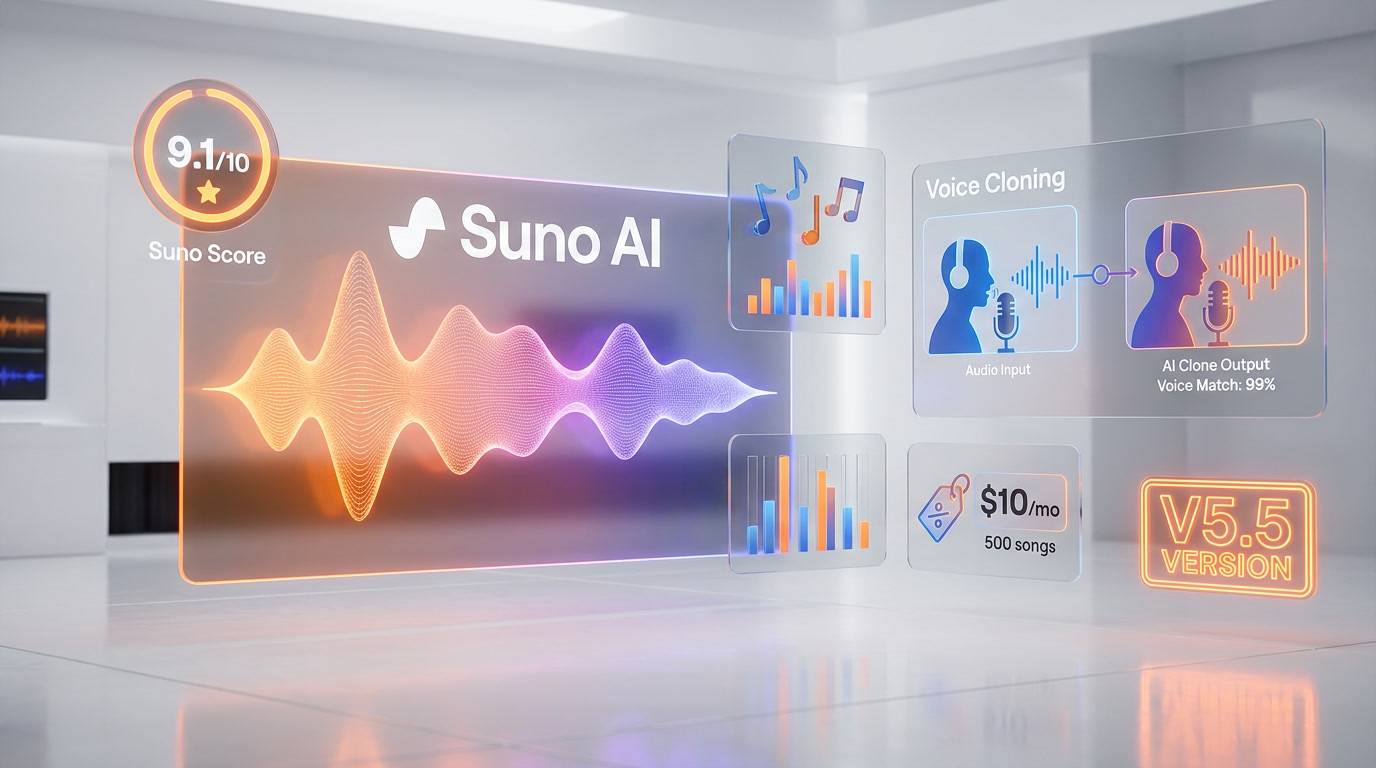
Suno AI is the leading AI music generation platform, founded in 2021 in Cambridge, Massachusetts by former Kensho engineers Mikey Shulman, Martin Camacho, Georg Kucsko and Keenan Freyberg. We rate it 9.1 out of 10. Suno lets anyone create full songs — vocals, instruments, lyrics — from a text prompt in under 30 seconds. The free plan gives 50 credits per day (~10 songs). Pro costs $8 per month (2,500 credits), Premier $24 per month (10,000 credits). As of May 2026, Suno has 2 million paid subscribers, $300M ARR, a $2.45 billion valuation, and over 100 million cumulative users worldwide. The March 26, 2026 v5.5 release added voice cloning (Voices), per-user fine-tuning (Custom Models), and adaptive preference learning (My Taste).
What separates Suno from every other AI music tool is the combination of vocal realism, melodic creativity and sheer accessibility. Where Google Lyria 3 Pro produces spatially richer audio and Udio iterates faster, Suno consistently writes better songs — with more natural vocal delivery, catchier melodies and more emotionally coherent structures. We scored Suno 9.1 out of 10, with features at 9.4 out of 10 and value at 9.0 out of 10. The March 26, 2026 release of v5.5 cemented that lead by introducing three game-changing personalization features: Voices (voice cloning with verification), Custom Models (fine-tune on your own catalog), and My Taste (adaptive preference learning).
Suno is headquartered in Cambridge, MA with around 366 employees. The company raised $375 million total, including a $250 million Series C led by Menlo Ventures in November 2025 at a $2.45 billion valuation. That same month, Suno settled its copyright lawsuit with Warner Music Group, signed a landmark licensing deal, and acquired Songkick — the concert discovery platform with 15 million users — signaling ambitions far beyond music generation.
Suno is best for: independent musicians, content creators, podcasters, game developers, filmmakers, and hobbyists who want professional-sounding music without years of training or expensive studio time. If you can describe what you want in words, Suno can make it.
Pricing at a Glance
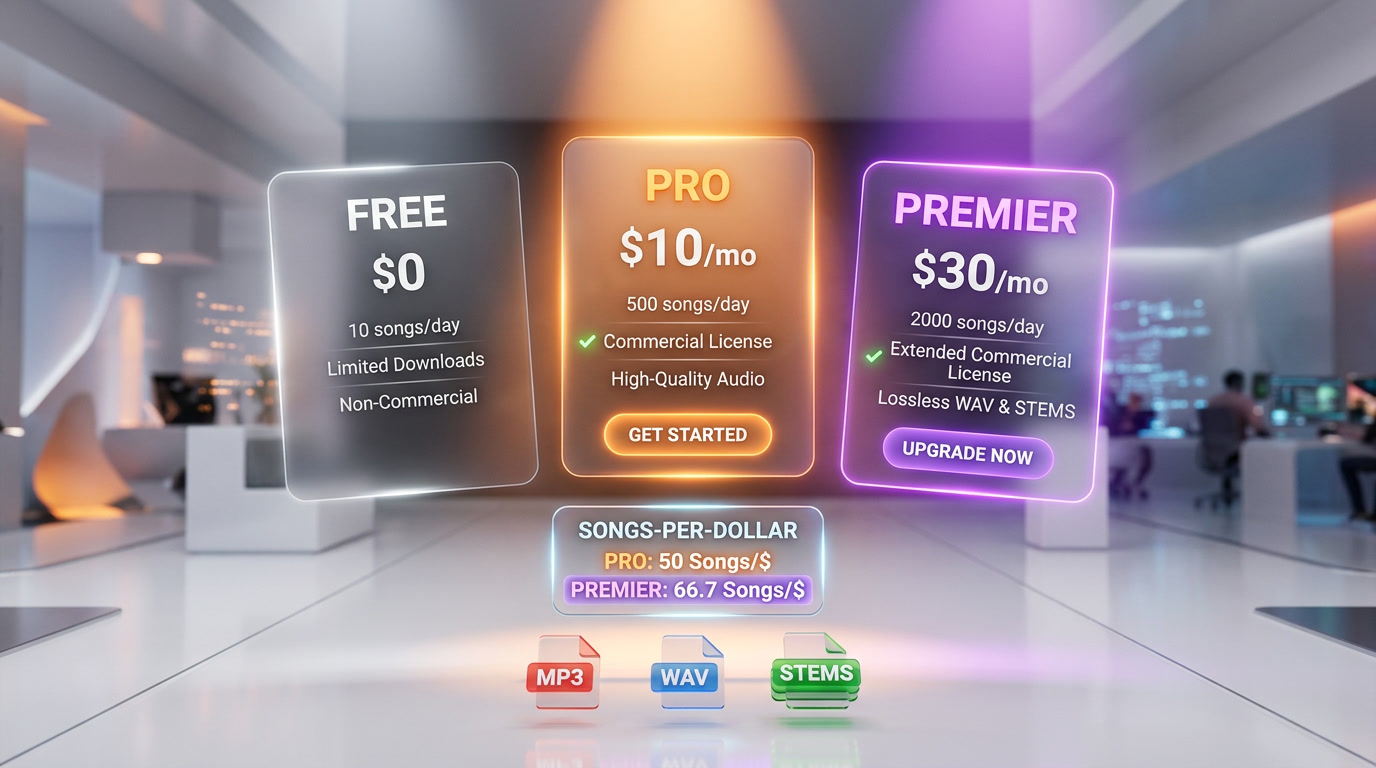
| Plan | Price/mo | Annual Price | credits per month | ~songs per month | Commercial Use |
|---|---|---|---|---|---|
| Free | $0 | $0 | 50/day | ~300 | No |
| Pro | $8 | $80 (save $16 per year) | 2,500 | ~500 | Yes |
| Premier | $24 | $240 (save $48 per year) | 10,000 | ~2,000 | Yes |
For context: Suno at $10 per month vs Udio at $10 per month vs Google Lyria 3 Pro bundled free with Gemini Advanced at $20 per month. Per-song cost, Suno is roughly 5x cheaper than Lyria on a volume basis. If you generate more than 10 tracks per month, Suno's Pro plan is the best value in the market.
Our Experience with Suno AI
We have been using Suno since the v3 era and have generated over 2,000 tracks across genres ranging from lo-fi beats to cinematic orchestral pieces to hip-hop. The jump from v4 to v5 was dramatic — vocals became nearly indistinguishable from human performance in many genres, and instrument separation improved significantly. With v5.5, the addition of Voices changed our workflow entirely: we recorded a 30-second vocal sample, passed verification, and within minutes were generating songs that sound like us. Custom Models trained on six of our original tracks produced output that captured our melodic tendencies with surprising accuracy. The platform is absurdly easy to use — type a prompt, wait 30 seconds, get a song — but the depth available through Studio gives serious musicians real production control.
Suno v5.5 Features Deep Dive
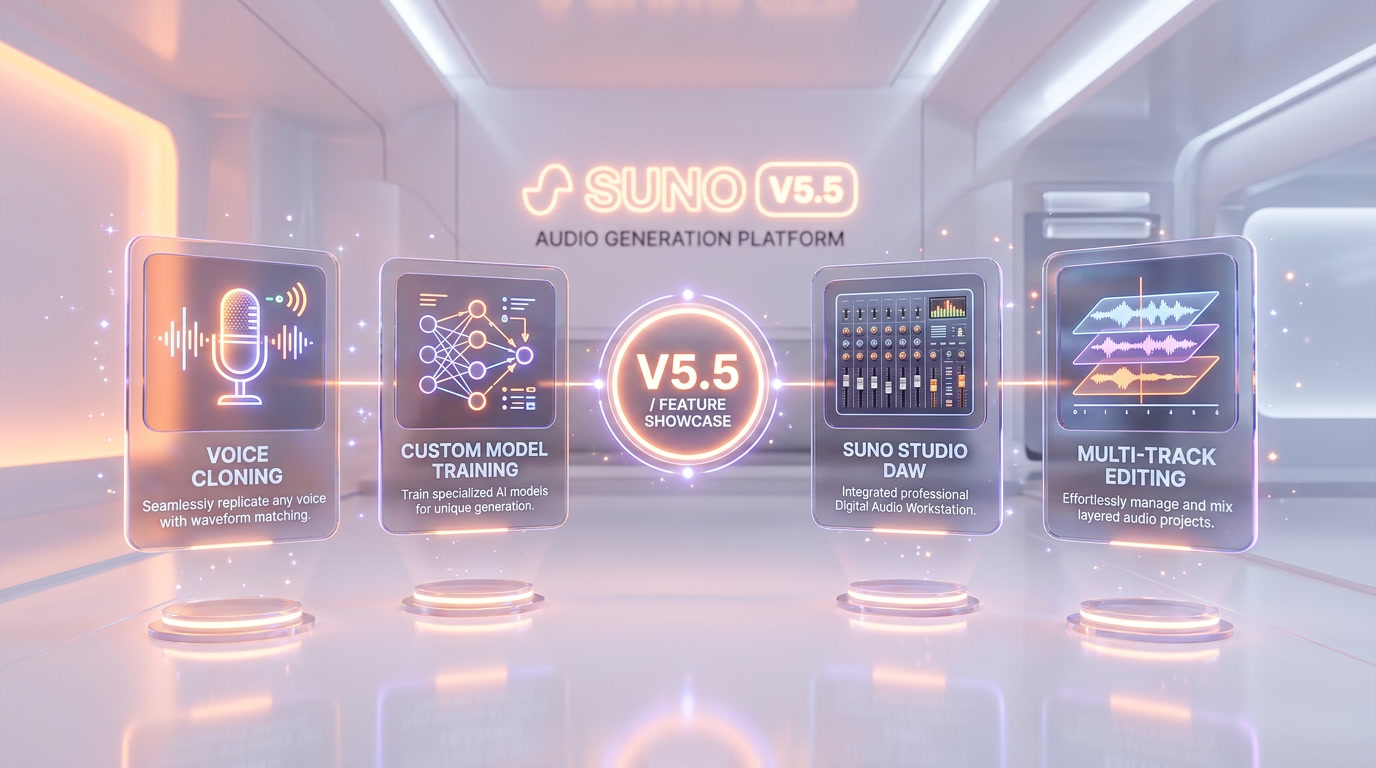
Released March 26, 2026, Suno v5.5 is described by the company as "our best and most expressive model yet." The core audio model itself produces more dynamic, emotionally nuanced output than v5 — better phrasing, more natural breathing in vocals, richer instrumental layering. But the real story is the three personalization features that ship alongside it.
Voices — Your Voice, AI Music
Voices is the most requested feature in Suno's history. It lets Pro and Premier subscribers capture their own singing voice and use it to generate new songs. The process is straightforward: you record or upload a short vocal sample (a few seconds of singing is enough), then speak a randomized verification phrase to prove the voice belongs to you. Once verified, Suno captures the essence of your vocal timbre, range and style — and stores it as a reusable voice profile linked to your account.
The verification step is critical and worth emphasizing. Unlike some voice-cloning tools that let you clone anyone from a YouTube clip, Suno requires a live spoken verification phrase that must match the singing voice — preventing unauthorized voice theft. This is a deliberate ethical choice: the company has stated that "the best music starts with a human," and the verification system ensures that human is actually you. Your voice remains private by default: only you can use it in your generations. Suno has announced plans for optional voice sharing in the future, but with full user control over permissions.
In our testing, Voices preserved vocal character remarkably well across genres. A folk voice sample produced convincing folk-rock, country and even jazz vocals. We tried generating R&B, pop ballads and even Latin reggaeton with the same voice profile, and the results maintained recognizable tonal characteristics while adapting naturally to each genre's demands. The model struggles more with extreme genre shifts — a soft tenor voice generating death metal, for instance — but within reasonable range, the results are impressively natural. The latency is minimal: generating a song with your voice takes the same ~30 seconds as a standard generation.
Custom Models — Train on Your Catalog
Custom Models let you upload six or more of your original tracks to fine-tune v5.5 on your personal style. The resulting model understands your compositional tendencies: chord progressions you favor, arrangement patterns, instrumentation choices, even lyrical themes. Pro and Premier subscribers can create up to three Custom Models, and each model can be trained on a different subset of your work — one for your upbeat material, one for your ambient pieces, one for your vocal-heavy tracks.
This is fundamentally different from Voices. Where Voices captures how you sound, Custom Models capture how you write. An indie artist who always gravitates toward minor-key progressions with layered guitars and introspective lyrics will get a model that naturally produces music in that vein — but with AI-generated variations that expand beyond what the artist might write alone. A hip-hop producer who uploads their beat catalog will get a model that understands their drum patterns, sample layering habits and arrangement structures.
The training process takes approximately 15-30 minutes depending on the number of tracks uploaded. We tested with eight original electronic tracks and the resulting model captured our tendency toward arpegiated synths and four-on-the-floor kicks with surprising accuracy. Once trained, you can combine Custom Models with Voices for the most personalized output possible: music that sounds like you and writes like you. This combination is genuinely unprecedented in any AI creative tool — it is the closest thing to an AI collaborator that actually knows your artistic identity.
My Taste — Adaptive Learning for Everyone
My Taste is the only v5.5 feature available to all users, including free tier. It works passively: as you create, like and save songs on Suno, the platform learns your preferences — favorite genres, moods, tempos, instrumentation. Over time, your generations become more aligned with your taste without you having to specify every detail in your prompts.
Think of it as a Spotify-like recommendation engine, but for creation rather than consumption. After roughly 50 interactions, we noticed our default generations started leaning toward the electronic-ambient territory we tend to prefer, with less prompting needed to get there. It is a subtle but meaningful quality-of-life improvement.
Suno Studio — The First AI-Native DAW
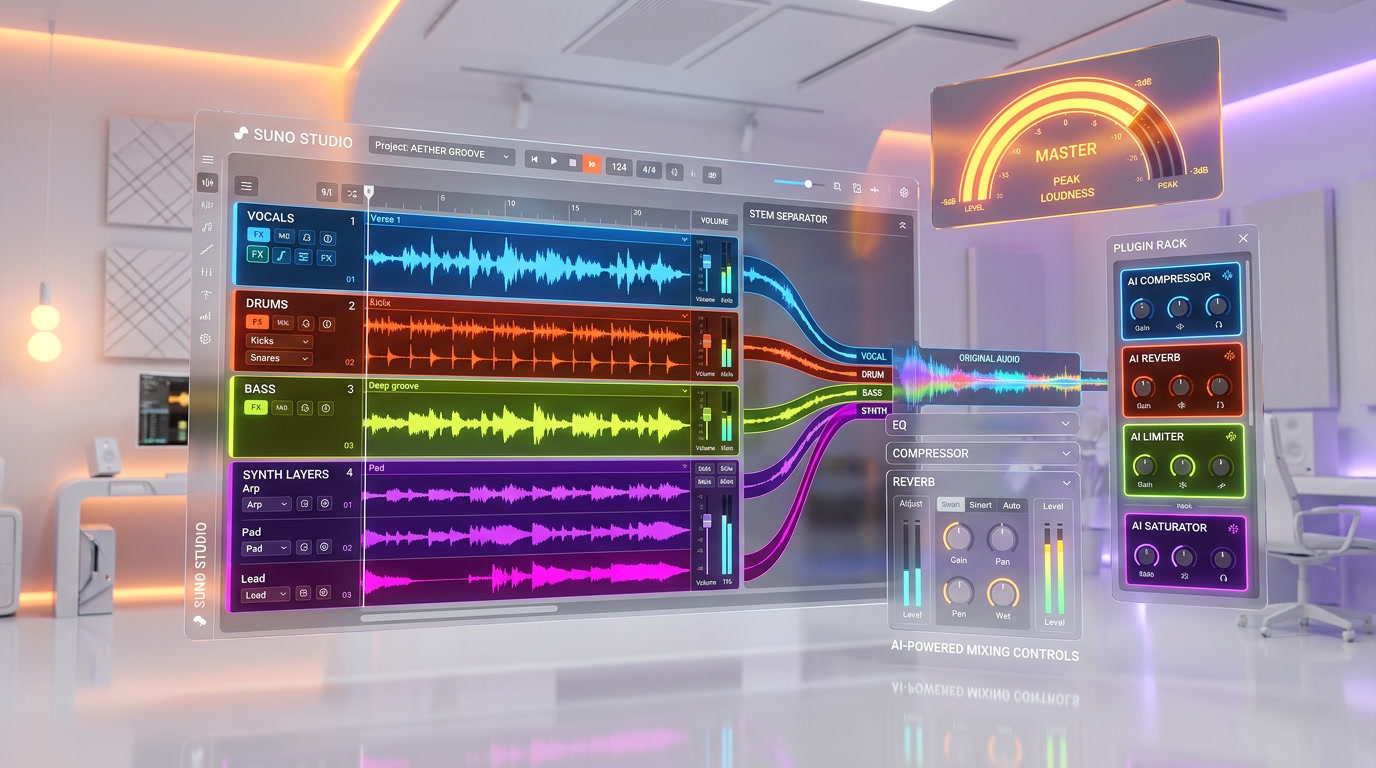
Suno Studio launched in September 2025 as a Premier-exclusive feature and received a major 1.2 update in February 2026. It is the first digital audio workstation built around AI generation rather than traditional recording. Where Logic Pro or Ableton Live start with silence and existing audio files, Studio starts with generation — you can create unlimited stem variations (vocals, drums, synths, bass) on the fly and arrange them on a professional multitrack timeline.
Studio Core Features
- Multitrack timeline editing — professional-grade arrangement with BPM control, volume and pitch adjustment per track
- Unlimited stem generation — generate vocals, drums, synths, bass and more as individual stems that flow with your existing audio
- MIDI + audio export — export stems as both audio and MIDI files to continue editing in any traditional DAW
- Remove FX (Studio 1.2) — strip effects from audio for custom processing
- Warp Markers + Quantize (Studio 1.2) — time-stretch and grid-lock recordings to your project BPM
- Alternates (Studio 1.2) — create and audition multiple takes per section
- Time signature support (Studio 1.2) — compose in 6/8, 7/8, 11/4 and beyond 4/4
- Start from any audio — import samples, stems, even hummed melodies and transform them into full arrangements
Studio bridges the gap between "AI generates everything" and "I want fine-grained control." A producer can generate 20 drum variations in seconds, pick the best three, layer them with hand-selected synth stems, export the MIDI to Ableton for further tweaking, then bring the final mix back into Studio for AI-assisted mastering. It is still in beta and has rough edges — the UI can feel laggy on complex projects and there is no plugin support yet — but the vision is clear and the execution is already usable for real production work.
Pricing Breakdown (March 2026)
Suno's pricing is simple compared to most SaaS tools. Three tiers, no hidden fees, clear credit system. Here is what each plan actually gives you.
Free Plan
The Free plan provides 50 credits per day that replenish at UTC midnight — roughly 10 songs daily, or about 300 songs per month. Credits do not roll over. You get access to v4.5-All (not the latest v5.5 for generation), non-commercial use only, and MP3 downloads. You cannot monetize, distribute commercially, or use free-tier songs in client work. The My Taste personalization feature is available on free tier, but Voices and Custom Models are not.
That said, 50 credits per day is remarkably generous for experimentation — substantially more than what Udio offers on its free tier (10 credits per day). It gives you enough runway to learn prompting techniques, explore genres, and determine whether upgrading is worth it. Many users stay on the free plan for weeks before subscribing.
Pro Plan — $8 per month
Pro unlocks 2,500 credits per month (roughly 500 songs), access to v5 and v5.5 models, commercial rights for all songs generated while subscribed, WAV downloads, Voices and Custom Models (up to 3). If your Pro credits run out, you fall back to the 50 free daily credits. Top-up credits are available for purchase and do not expire as long as your subscription is active.
The commercial rights provision is generous: songs generated during an active Pro subscription retain commercial rights even if you later cancel. This means a musician could subscribe for one month, generate an album's worth of material, and legally release it commercially afterward.
Premier Plan — $24 per month
Premier provides 10,000 credits per month (roughly 2,000 songs), everything in Pro, plus exclusive access to Suno Studio, stem export, early access to new features, and unlimited downloads. For serious creators producing high volumes of content — YouTube channels, podcast networks, game studios — Premier pays for itself immediately. At roughly $0.015 per song, there is nothing remotely comparable in cost.
Annual Billing
Both Pro and Premier offer 20% discounts on annual billing: Pro drops to ~$8 per month ($96 per year) and Premier to ~$24 per month ($288 per year). Given the platform's trajectory, annual billing is an easy recommendation for anyone who plans to use Suno regularly.
The Copyright Question
No Suno review would be complete without addressing copyright. In mid-2024, the RIAA filed lawsuits against both Suno and Udio on behalf of major record labels including Universal, Sony and Warner. The allegation: both companies trained their models on copyrighted music without authorization.
Suno's response came in November 2025 with a landmark settlement and licensing deal with Warner Music Group. The agreement settled the lawsuit and established what both parties called a "first-of-its-kind partnership" to build licensed AI music models. Key terms include: WMG artists and songwriters get full control over whether and how their names, images, likenesses, voices and compositions are used; Suno will launch new licensed models built on authorized data in 2026, deprecating current models; and Suno acquired WMG's Songkick platform (15 million users) as part of the deal.
The practical impact for users: songs generated on current models retain their existing rights. When the new licensed models launch in 2026, Suno will transition to them. Free users will lose off-platform download capability, and paid users will face download caps — details still evolving. The Warner deal does not resolve the Sony and Universal lawsuits, which remain pending, but it signals the direction the industry is heading: from litigation to licensing.
For commercial use, our recommendation is straightforward. If you are a Pro or Premier subscriber generating original compositions (not trying to replicate specific copyrighted songs), your risk is minimal. Suno's terms grant you commercial rights, and the Warner deal demonstrates the company is investing heavily in legal compliance.
Who Should Use Suno AI?
| User Type | Best Plan | Why |
|---|---|---|
| Hobbyist / Curious | Free | 10 songs per day is plenty to experiment. Zero commitment. |
| Content Creator | Pro ($8 per month) | 500 songs per month with commercial rights. Background music for YouTube, podcasts, TikTok. |
| Independent Musician | Pro or Premier | Voices + Custom Models to create music that sounds like you. Studio for production control. |
| Game Developer | Premier ($24 per month) | Stem export + MIDI for integration into game engines. Volume pricing at ~$0.015 per song. |
| Music Producer | Premier ($24 per month) | Studio DAW, unlimited stems, export to Ableton/Logic. AI as a creative partner, not replacement. |
| Brand / Agency | Premier ($24 per month) | Commercial rights, high volume, custom branding via Custom Models. |
If you do not make music and do not create content, Suno is still worth trying on the free plan — generating a song from a text prompt is one of the most viscerally impressive AI demos available today. But the real value unlocks at Pro tier, where commercial rights and the v5.5 model transform it from a toy into a tool.
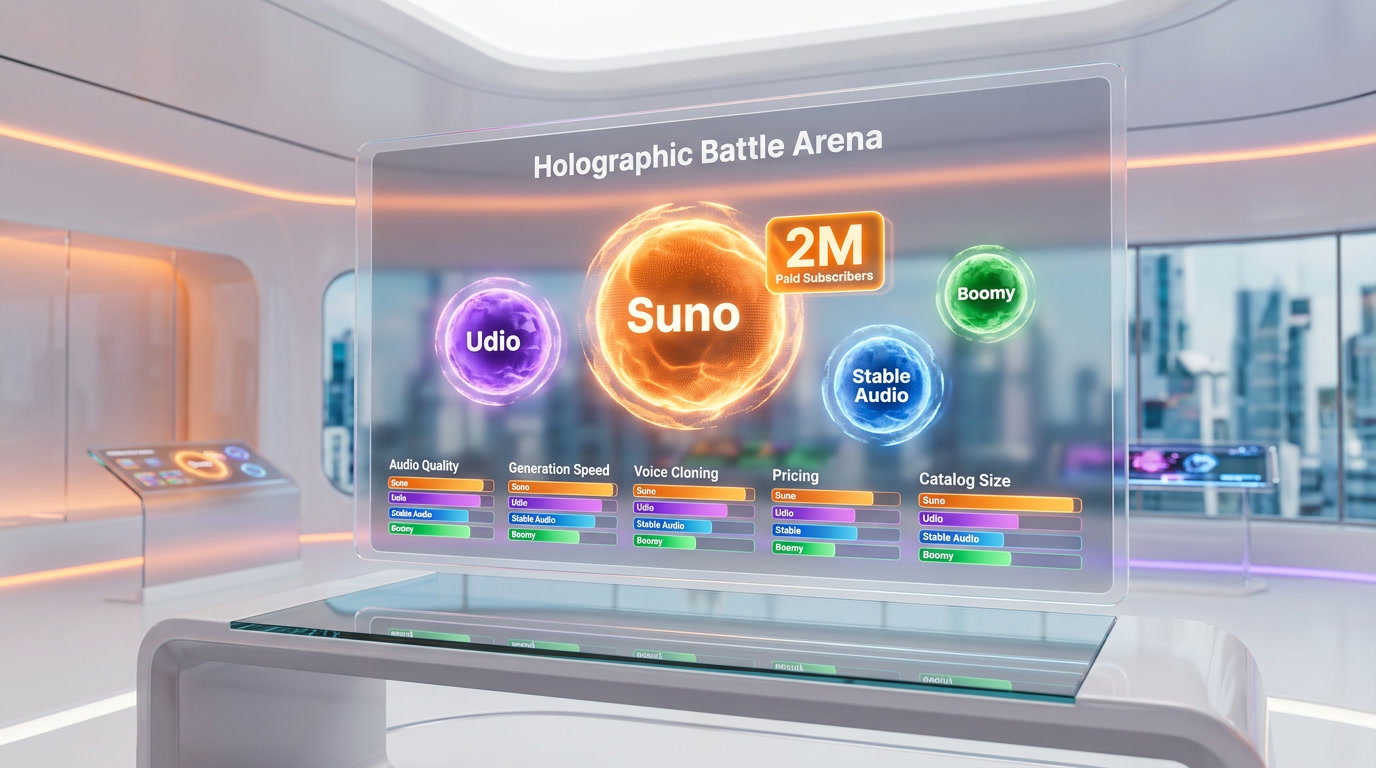
Suno AI vs the Competition
The AI music generation space has matured rapidly in 2026. Here is how Suno stacks up against the three most relevant competitors.
| Feature | Suno v5.5 | Google Lyria 3 Pro | Udio |
|---|---|---|---|
| Audio Quality | Excellent — best vocals | Excellent — best spatial audio | Very Good |
| Vocal Realism | Industry-leading | Good | Good |
| Song Structure Control | Good (prompt-based) | Excellent (bar-level control) | Good |
| Voice Cloning | Yes (verified) | No | No |
| Custom Model Training | Yes (up to 3) | No | No |
| Stem Export | Yes (Premier) | No | Yes |
| DAW / Studio | Yes (Suno Studio) | No | No |
| MIDI Export | Yes (Studio) | No | No |
| Free Tier | 50 credits per day (~10 songs) | Free with Gemini | 10 credits per day |
| Paid Price | $10-30/mo | $20 per month (Gemini Advanced) | $10-30/mo |
| Commercial Rights | Pro + Premier | Yes (with watermark) | Paid tiers |
| AI Watermark | No | Yes (SynthID) | No |
| Licensed Training Data | Coming 2026 (Warner deal) | Yes (YouTube/Google) | Pending lawsuits |
Suno vs Google Lyria 3 Pro: Google launched Lyria 3 Pro on March 25, 2026 — one day before Suno v5.5. Lyria produces fuller, spatially richer audio and offers superior structure control (you can specify exact bar counts per section). But Suno wins on vocal realism, melodic creativity, personalization (Voices, Custom Models), production tools (Studio), and per-song economics at scale. If you make 5-10 tracks per month, Lyria bundled with Gemini is competitive. If you make 100+, Suno is dramatically cheaper.
Suno vs Udio: Udio is the closest direct competitor — similar pricing, similar feature set. Udio iterates faster (shorter generation times) and some users prefer its electronic music output. But Suno has a larger user base (2M paid vs Udio's undisclosed numbers), a more developed feature set (Voices, Custom Models, Studio), and the Warner licensing deal provides stronger legal footing. Udio's ongoing litigation with major labels remains unresolved.
Suno vs Eleven Music: the newest entrant comes from the voice side of the market. We ran the two across three weeks and sixty-odd generated tracks in Eleven Music versus Suno AI, and Suno takes it overall on song length, voice cloning and Studio stem editing — Eleven Music answers with notably clean studio audio and native multilingual vocals, which makes it the better pick for short-form work in non-English languages.
Bottom Line
Suno AI is not just the best AI music generator — it is building the platform that will define how humans and AI make music together. The v5.5 update with Voices, Custom Models and My Taste transforms Suno from a novelty into a genuine creative instrument. Studio turns it into a production environment. The Warner Music deal gives it a path to full legal legitimacy. And with 2 million paying subscribers, $300M ARR and a $2.45B valuation, this is not a startup that might disappear — it is an industry.
The trajectory tells the story: from $200M to $300M ARR in three months. From zero to 100 million cumulative users in just over two years. From copyright defendant to Warner Music licensing partner. From text-to-song novelty to the first AI-native DAW with multitrack editing, stem generation and MIDI export. No other AI music company is moving this fast on this many fronts simultaneously.
The free tier is generous enough to try without commitment. Pro at $8 per month is the sweet spot for most creators. Premier at $24 per month is a no-brainer for anyone producing music at volume. We score Suno AI 9.1 out of 10 — the highest we have given any creative AI tool — because it delivers on the hardest promise in AI: making something that genuinely feels human.
FAQ
Is Suno AI free to use?
Yes. Suno's free plan gives you 50 credits per day (roughly 10 songs). Credits replenish daily at UTC midnight. Free songs are for personal, non-commercial use only and are limited to the v4.5-All model. No credit card required to start.
Can I use Suno AI songs commercially?
Yes, but only on Pro ($8 per month) or Premier ($24 per month) plans. Songs generated during an active paid subscription retain commercial rights permanently — even if you later cancel. Free-tier songs cannot be monetized. Commercial use covers streaming releases, YouTube, podcasts, client work, apps, games and advertising.
How does Suno AI compare to Google Lyria 3 Pro?
Suno v5.5 and Google Lyria 3 Pro launched within a day of each other in March 2026. Lyria produces richer spatial audio and offers bar-level structure control. Suno leads in vocal realism, personalization (voice cloning, custom model training), production tools (Studio DAW with stem and MIDI export), and cost-per-song at scale. Lyria includes a SynthID watermark on all generated audio; Suno does not watermark output.
What is Suno Studio and who can use it?
Suno Studio is the world's first AI-native digital audio workstation (DAW), available exclusively to Premier subscribers ($24 per month). It launched in September 2025 with a major 1.2 update in February 2026. Studio offers multitrack timeline editing, unlimited stem generation, MIDI and audio export, BPM control, warp markers, alternates, and time signature support beyond 4/4. It is still in beta but already usable for real production work.
Is Suno AI legal to use? What about copyright?
Suno settled its copyright lawsuit with Warner Music Group in November 2025 and signed a landmark licensing deal to build new AI models on authorized training data in 2026. Lawsuits from Sony and Universal remain pending. For users: songs generated on paid plans have commercial rights granted by Suno's terms of service. Suno recommends creating original compositions rather than trying to replicate specific copyrighted songs. The Warner deal signals the industry is moving from litigation to licensing.
Frequently Asked Questions
Is Suno AI better than Udio?
For most users, yes. Suno scores 9.1 out of 10 and consistently produces more emotionally coherent songs with more natural vocal delivery than Udio. Both cost $10 per month at the entry tier, offering roughly 500 songs per month. Udio iterates faster in the generation loop, but Suno V5.5 voice cloning and Custom Models give it a decisive edge for artists wanting personalized, human-sounding output. If all you need is rapid background music iteration, Udio is viable. For full vocal songs and creative control, Suno wins.
How does Suno AI compare to Google Lyria 3 Pro?
Google Lyria 3 Pro is bundled free with Gemini Advanced at $20 per month and produces spatially richer, more cinematic audio. Suno Pro at $8 per month gives ~500 songs per month with better vocal melodies and more coherent song structures. On a per-song volume basis, Suno is roughly 5x cheaper than Lyria. For songwriters and content creators who need full vocal tracks, Suno is the stronger choice. For film composers and sound designers prioritizing atmospheric instrumental audio, Lyria 3 Pro is competitive.
Who should use Suno AI?
Suno is ideal for independent musicians, content creators, podcasters, game developers, filmmakers and hobbyists who want professional-sounding music without studio experience. The free plan (50 credits per day, ~300 songs per month) suits casual users. The Pro plan at $10 per month (~500 songs, commercial rights) is the best-value AI music subscription on the market if you generate more than 10 tracks per month. The Premier plan at $30 per month is designed for serious producers who need DAW-level control via Suno Studio.
What are Suno AI's limitations?
Suno's main limitations are: (1) ongoing copyright lawsuits from major record labels create legal uncertainty around commercial output, despite the November 2025 Warner Music Group settlement; (2) no official public API — developers must rely on unsupported third-party middleware; (3) Suno Studio, the AI-native DAW, is locked behind the $30 per month Premier plan; (4) non-English vocal quality noticeably trails English; (5) voice cloning is restricted to Pro ($8 per month) and Premier ($24 per month) subscribers and cannot be used on the free tier.
Does Suno AI integrate with any DAW or external tools?
Suno does not offer native integrations with external DAWs like Ableton, Logic Pro or Pro Tools. Premier subscribers can export stems and MIDI files from Suno Studio, which can then be imported into any standard DAW for further production. There is no official public API as of April 2026, so automated integrations with tools like Zapier or Make require unofficial third-party middleware. Audio export is available on all paid plans in standard formats.
Is the Suno AI free plan actually free?
Yes — fully free, no credit card required. The free plan gives 50 credits per day, which equates to roughly 10 songs per day or approximately 300 songs per month. The critical limitation: free-tier songs carry no commercial rights and cannot be used in monetized content, YouTube channels with revenue, client projects or any commercial context. For commercial use, the Pro plan at $10 per month (2,500 credits, ~500 songs) is required.
What is Suno Studio and how does it differ from the standard editor?
Suno Studio is the world's first AI-native Digital Audio Workstation, exclusive to the Premier plan at $30 per month. It adds a multitrack timeline interface, stem separation, individual track editing, audio and MIDI export, BPM control and pitch adjustment — giving professional producers genuine production control over AI-generated music. Standard Pro users ($10 per month) get the basic generation interface without timeline editing, stem access or MIDI export. For music production workflows, Studio is a meaningful upgrade.
Can I use Suno AI music commercially?
Commercial rights are included on all paid plans: Pro at $8 per month and Premier at $24 per month. Free-tier generations are for personal use only. However, users operating in commercial contexts should be aware that major record labels have filed copyright lawsuits against Suno. The November 2025 settlement with Warner Music Group and a subsequent licensing deal are positive signals, but AI music copyright law remains evolving. Consult legal counsel for high-stakes commercial applications.
Key Features
Pros & Cons
Pros
- V5.5 produces studio-quality full songs with realistic vocals from a text prompt
- Suno Studio is the first AI-native DAW with multitrack timeline and MIDI export
- Voice cloning lets Pro/Premier users sing AI songs in their own voice
- Custom Models fine-tune the AI on your uploaded tracks
- Generous free plan with 50 daily credits — no credit card required
- Commercial rights included on all paid plans
- Cross-platform: Web, iOS, Android with full feature parity
Cons
- Ongoing copyright lawsuits from major record labels create legal uncertainty
- No official public API — developers rely on third-party middleware
- Suno Studio locked behind the $24 per month Premier plan
- Non-English vocal quality still trails English output
- Voice cloning limited to Pro and Premier subscribers only
Best Use Cases
Platforms & Integrations
Available On
Integrations
Compare Suno AI

We're developers and SaaS builders who use these tools daily in production. Every review comes from hands-on experience building real products — DealPropFirm, ThePlanetIndicator, PropFirmsCodes, and many more. We don't just review tools — we build and ship with them every day.
Written and tested by developers who build with these tools daily.
Frequently Asked Questions
What is Suno AI?
The AI music generator that lets anyone create full songs with vocals in minutes
How much does Suno AI cost?
Suno AI has a free tier. Premium plans start at $10/month.
Is Suno AI free?
Yes, Suno AI offers a free plan. Paid plans start at $10/month.
What are the best alternatives to Suno AI?
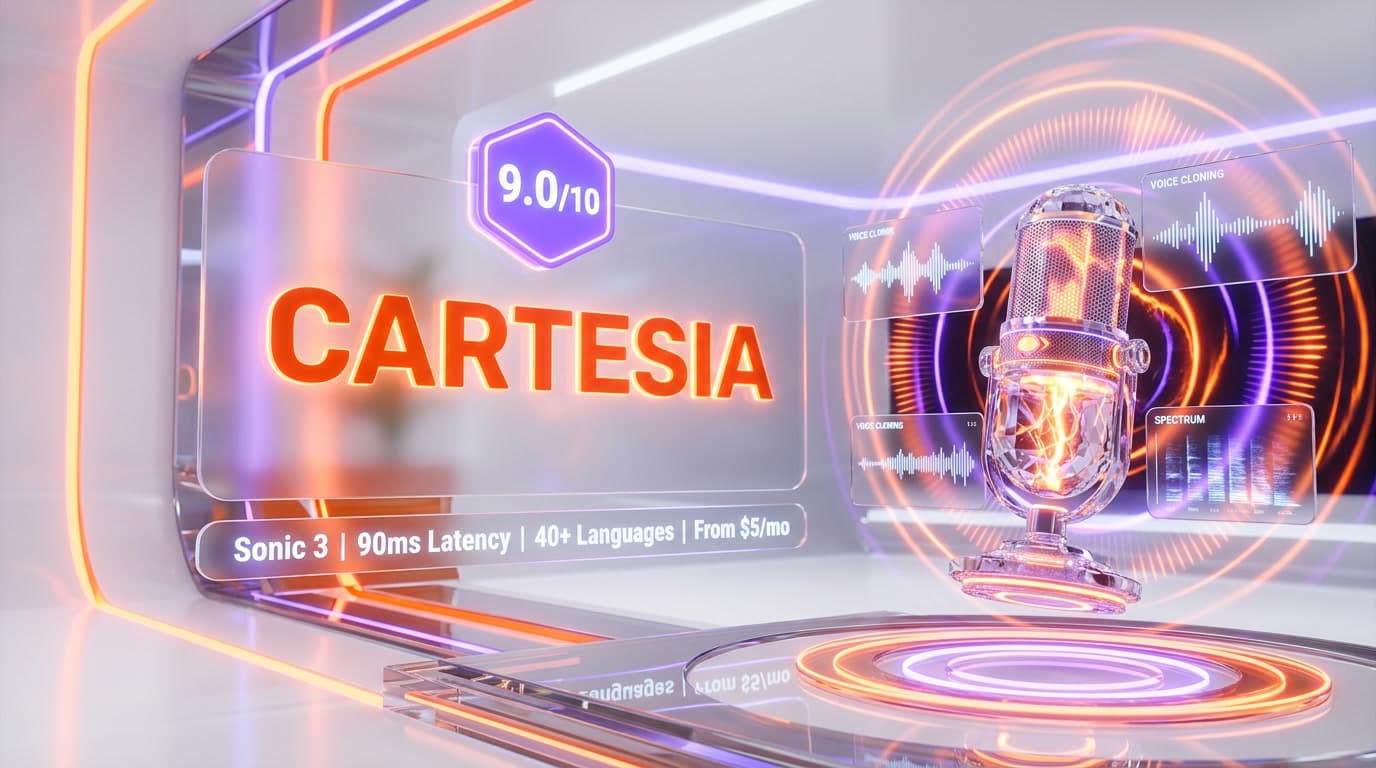
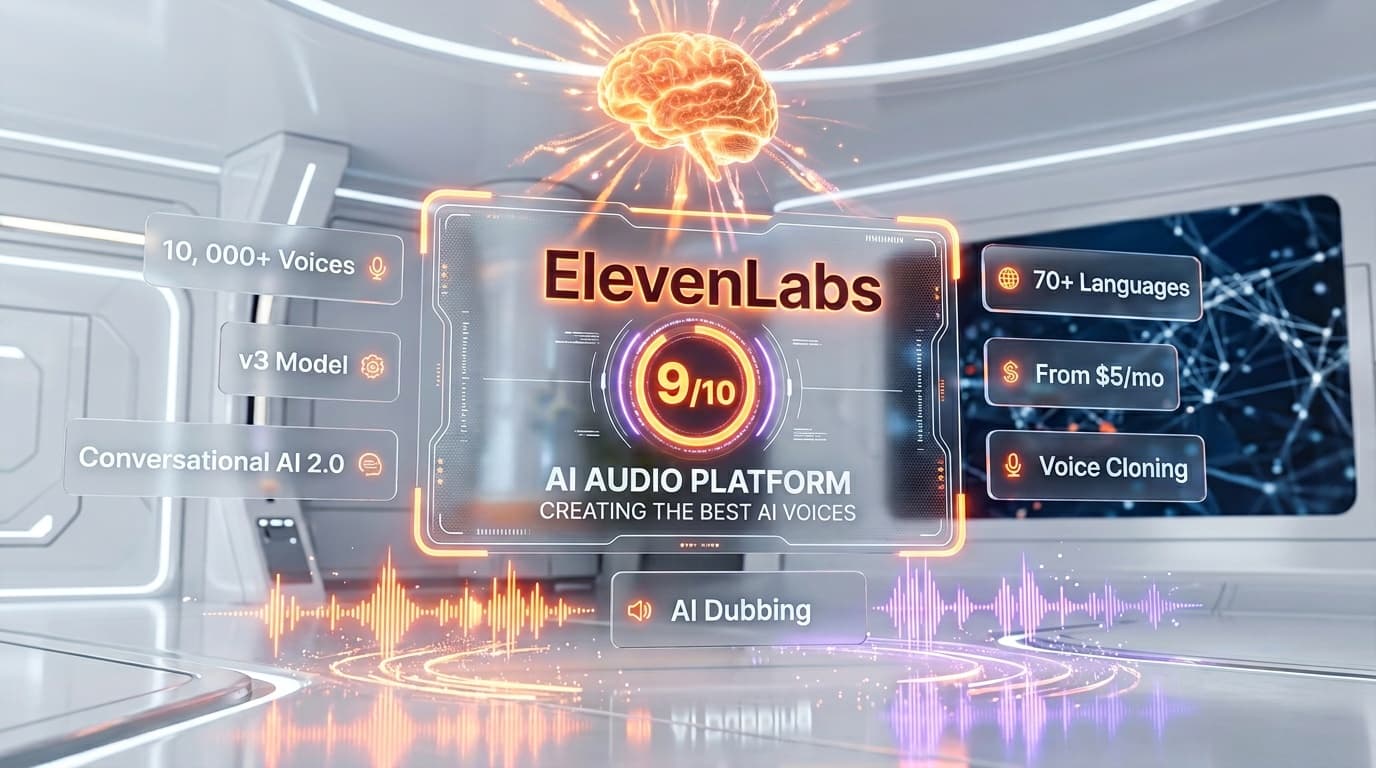
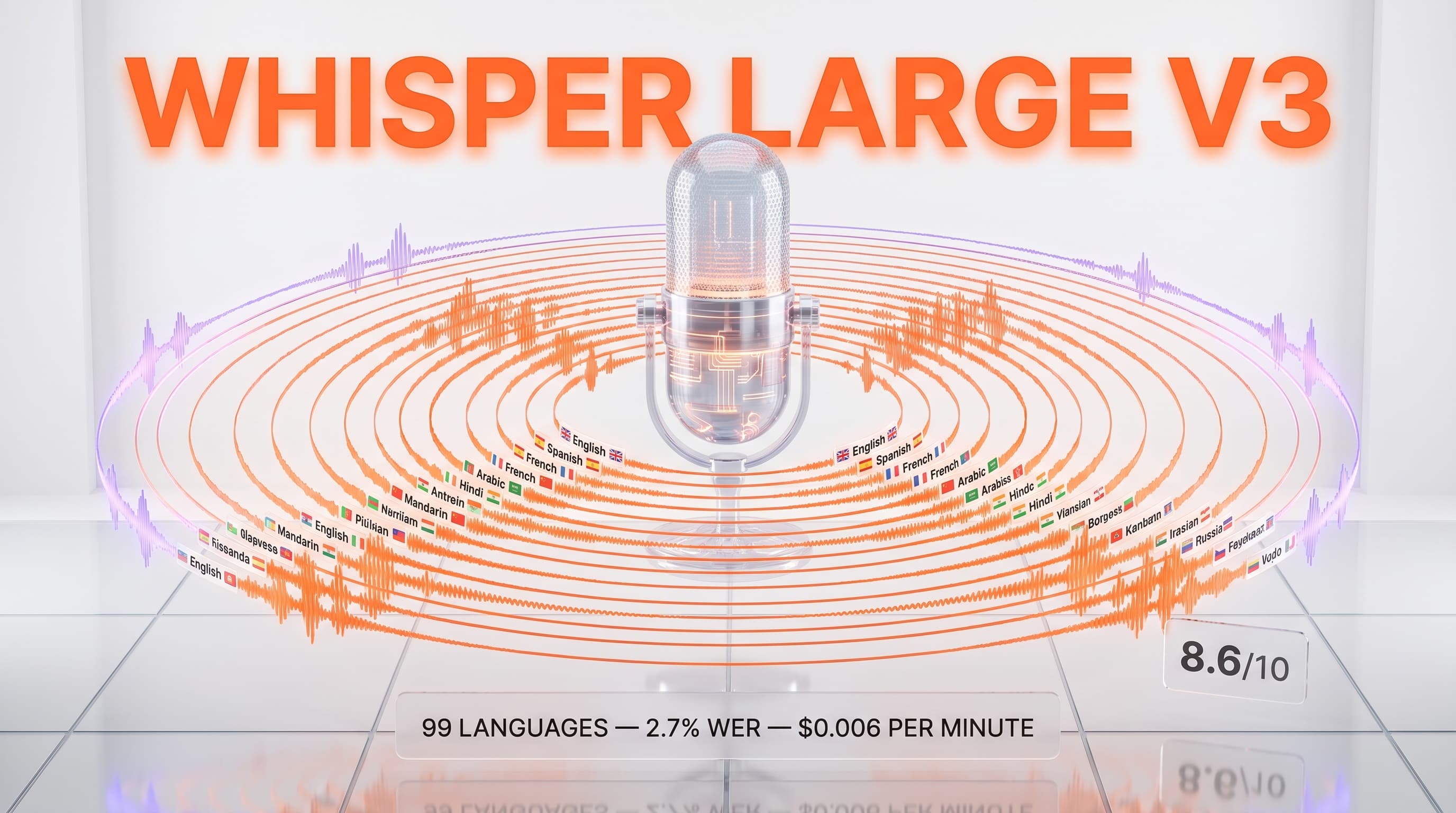
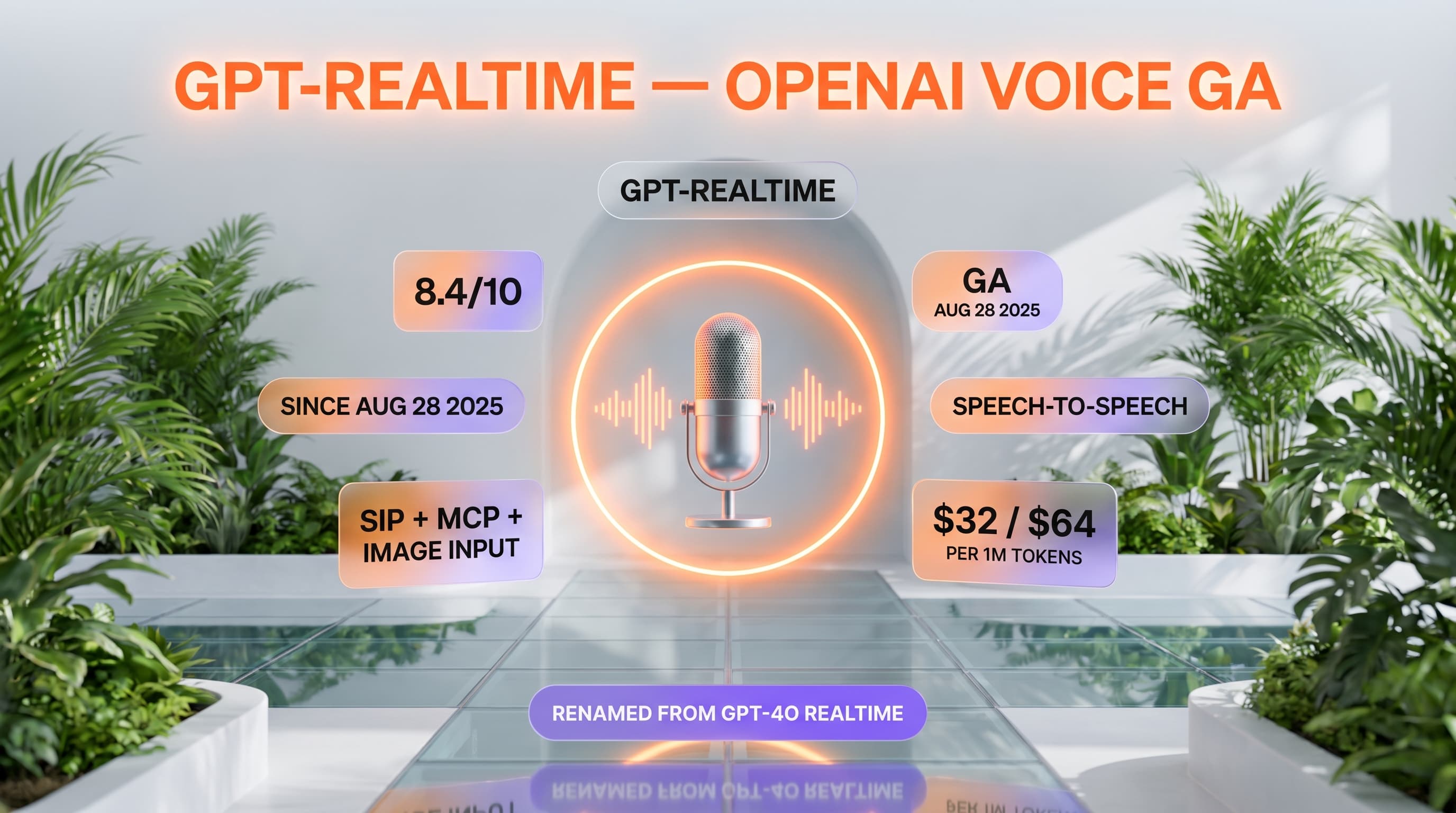
Top-rated alternatives to Suno AI include Cartesia (9/10), ElevenLabs (9/10), Whisper Large v3 (8.6/10), gpt-realtime (8.4/10) — all reviewed with detailed scoring on ThePlanetTools.ai.
Is Suno AI good for beginners?
Suno AI is rated 9.2/10 for ease of use.
What platforms does Suno AI support?
Suno AI is available on Web, iOS, Android.
Does Suno AI offer a free trial?
No, Suno AI does not offer a free trial.
Is Suno AI worth the price?
Suno AI scores 8.8/10 for value. We consider it excellent value.
Who should use Suno AI?
Suno AI is ideal for: Independent musicians creating demos, Content creators generating royalty-free music, Songwriters prototyping in their signature style, Vocalists cloning their voice for AI tracks, Game developers generating adaptive soundtracks, Marketers creating branded jingles at scale, Music educators teaching composition, Hobbyists turning ideas into produced songs.
What are the main limitations of Suno AI?
Some limitations of Suno AI include: Ongoing copyright lawsuits from major record labels create legal uncertainty; No official public API — developers rely on third-party middleware; Suno Studio locked behind the $24 per month Premier plan; Non-English vocal quality still trails English output; Voice cloning limited to Pro and Premier subscribers only.
Best Alternatives to Suno AI
Ready to try Suno AI?
Start with the free plan
Try Suno AI Free →